
Philippines Africa business relationships are developing through infrastructure operations, digital financial services, and international connectivity. Although bilateral merchandise trade remains relatively limited, companies are establishing commercial links by transferring operating capabilities and developing local partnerships.
ASEAN–Africa: The Next Corridor, developed by Eurogroup Consulting in collaboration with the Alliance des Patronats Francophones (APF) and the Cambodia Chamber of Commerce (CCC), examines these emerging relationships.
Launched at REF 2026 in Phnom Penh on 14 November, the whitepaper highlights how Philippine and African companies can benefit from complementary expertise in ports, financial services, and infrastructure.
For business leaders, these examples illustrate opportunities extending beyond conventional import-export activities.
Philippines–Africa Business Goes Beyond Merchandise Trade
Commercial relationships between the Philippines and Africa increasingly involve services, infrastructure, and the transfer of business models.
Several areas offer potential for cooperation:
- Port operations: Philippine expertise in international terminal management can support African logistics infrastructure.
- Digital banking: African financial-service models can be adapted to Philippine consumer markets.
- Aviation connectivity: International air networks facilitate business travel and commercial relationships.
- Industrial services: Engineering and distributed-energy capabilities may support selected African infrastructure needs.
These activities demonstrate how economic cooperation can develop without relying exclusively on large merchandise flows.
Companies can participate through operating partnerships, investment, technology, and infrastructure development.
The ASEAN–Africa: The Next Corridor whitepaper examines these opportunities within the wider ASEAN–Africa economic corridor.
How ICTSI Is Strengthening African Trade Gateways
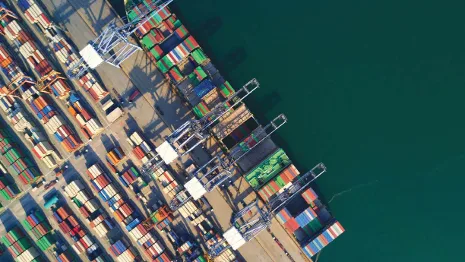
International Container Terminal Services, Inc. (ICTSI) provides an established example of Philippine infrastructure capabilities operating in African markets.
The Philippine port operator has developed a global network spanning more than 30 terminals, according to the whitepaper.
Its African operations include facilities in Madagascar, Nigeria, Cameroon, the Democratic Republic of the Congo, and South Africa.
The company’s expansion demonstrates how international port-management expertise can support the development of maritime gateways.
In 2026, ICTSI expanded its African operations through a long-term partnership involving Durban Container Terminal Pier 2 in South Africa.
The agreement with Transnet covers a 25-year operating partnership, as described in the whitepaper.
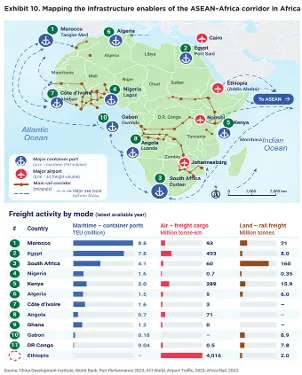
This development illustrates how port concessions can combine international operating expertise with local infrastructure requirements.
However, terminal investment must be supported by cargo demand, efficient operations, and reliable inland transport connections.
The commercial value of a port depends on its ability to serve businesses and consumers beyond the terminal itself.
African Digital Banking Innovation Finds a Market in the Philippines
The corridor also supports the transfer of business models from Africa into Southeast Asia.
Tyme Group provides an example through its digital banking operations.
The company developed TymeBank in South Africa before launching GoTyme Bank in the Philippines through a partnership with the Gokongwei Group.
Its operating model combines digital banking with physical customer touchpoints, including retail-based kiosks and banking assistance.
This approach supports customers who may benefit from face-to-face assistance when accessing digital financial services.
According to company information cited in the whitepaper, GoTyme had attracted more than 9 million customers by 2026.
The example demonstrates how a financial-service model developed in Africa can be adapted to a Southeast Asian market.
Nevertheless, successful replication depends on regulation, consumer behavior, distribution networks, and customer acquisition costs.
Addis Ababa Is Connecting Manila With African Markets
Aviation links provide another foundation for commercial relationships.
The whitepaper highlights Ethiopian Airlines‘ development of Addis Ababa as an intercontinental hub linking Southeast Asian cities with destinations across Africa.
Manila is among the ASEAN gateways served by the airline.
Through Addis Ababa, Ethiopian Airlines connects its Southeast Asian network with more than 60 African destinations, according to the whitepaper.
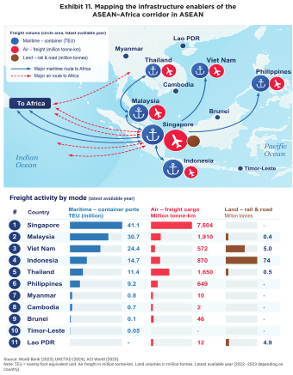
This hub-based system allows businesses and travelers to access multiple markets without requiring direct flights between every country pair.
Improved connectivity can support investment, professional mobility, tourism, and commercial engagement.
However, transportation alone cannot guarantee successful business development.
Companies still need reliable partners, market intelligence, and an understanding of local regulations.
As Patricia Veringa-Gieskes, Founder of The Job Factory and Board Member of the Fédération des Entreprises du Congo, observes in the whitepaper:
“Practical connectivity also matters: more direct routes, more competitive maritime transport and simpler administrative procedures will make trade much smoother.”
Her perspective emphasizes the importance of practical infrastructure and administrative conditions.
Where Can Philippine Companies Find Opportunities in Africa?
The Philippines has capabilities that may be relevant to selected African infrastructure and service markets.
However, opportunities must be assessed according to commercial demand and implementation feasibility.
For companies considering expansion, several factors are important:
- Sector relevance: Identify where Philippine expertise matches African infrastructure or customer needs.
- Market access: Evaluate transport connections, regulatory requirements, and distribution arrangements.
- Partner selection: Assess local operators, investors, and institutional relationships.
- Commercial feasibility: Review financing, operating costs, and implementation risks.
These considerations are particularly relevant to infrastructure operators, technology providers, and specialist service companies.
For businesses evaluating cross-regional opportunities, Philippines market research and strategic consulting can support market assessment and investment planning.
Frequently Asked Questions
Which Philippine company operates ports in Africa?
International Container Terminal Services, Inc. operates terminals across several African markets, including Madagascar, Nigeria, Cameroon, the Democratic Republic of the Congo, and South Africa. Its international activities demonstrate how Philippine port-management expertise can support logistics infrastructure and commercial connectivity.
What is ICTSI’s role at Durban Container Terminal?
The whitepaper describes ICTSI’s involvement in Durban Container Terminal Pier 2 through a long-term partnership with Transnet in 2026. The arrangement represents an expansion of the company’s African operations. Its commercial performance depends on terminal efficiency, cargo demand, and inland logistics.
How is African digital banking connected to the Philippines?
South Africa’s Tyme Group expanded into the Philippines through GoTyme Bank, developed with the Gokongwei Group. The model combines digital financial services with physical retail-based assistance. Its development demonstrates how African fintech capabilities can be adapted to Southeast Asian consumer markets.
How does Ethiopian Airlines connect Manila with Africa?
Ethiopian Airlines links Manila with destinations across Africa through its Addis Ababa hub. This provides connections to multiple African markets through a single international network. Such services can support business travel, investment activity, commercial partnerships, and broader economic cooperation.
Explore New Business Links Between the Philippines and Africa
Port operations, digital banking, and aviation demonstrate how Philippine and African businesses can develop relationships beyond conventional merchandise trade.
For executives and investors, the full whitepaper provides deeper analysis of cross-regional business models, infrastructure opportunities, and the conditions supporting sustainable ASEAN–Africa cooperation.
